Education
Welcome — this space is dedicated to education, clarity, and informed discussion.
Below you’ll find a range of information to dive into, covering canine behaviour, training foundations, welfare considerations, and best-practice handling in shared public spaces. The content here is designed to support understanding, encourage learning, and promote thoughtful, evidence-informed approaches.
Below you will find education, experience, and knowledge contributed by full members.
Online Courses
Canine First Aid Course Via Skool

This professionally developed canine first aid refresher course supports ongoing professional development within dog walking environments. It incorporates structured handbook learning, knowledge assessment, and practical competency demonstration to reinforce applied skills, situational awareness, and evidence-informed decision-making, contributing to Continuing Professional Development (CPD).
5 Fundamentals of Professional dog walking
1. Welfare First
Every decision prioritizes canine welfare — physical, emotional, and behavioral. Safety, comfort, and individual needs come before convenience or profit.
2. Knowledge & Education
Understanding dog behavior education, including canine behavior, body language, learning theory, and breed tendencies, is essential. Professional practice is grounded in education, not assumptions.
3. Risk Assessment & Management
Routes, environments, group composition, equipment, weather, and public interactions are continually assessed. Prevention is the cornerstone of professionalism.
4. Accountability & Professional Standards
Clear policies, insurance, record-keeping, client communication, and ethical conduct underpin trust. Professionals operate transparently and responsibly.
5. Advocacy & Public Responsibility
Professional dog walkers advocate for dogs in shared spaces — managing interactions, educating the public when appropriate, and modeling best practices at all times.
Professional dog walking isn’t 'just walking dogs.' It’s a skilled, accountable service with welfare and safety at its core, grounded in the dog walking fundamentals.

Education
On Lead Vs Off the Lead
When you see a dog on lead, it’s usually a deliberate choice reflecting canine welfare. Being on lead can indicate:
• training in progress
• behavioral management
• recovery or rehabilitation
• safety for people, dogs, or the handler
A lead is not a judgment — it’s a form of communication.
Allowing off-lead dogs to approach on-lead dogs removes that choice and increases risk for everyone involved. Good intentions don’t replace control.
- Let’s add some context and scale
In Christchurch, there are approximately:
• 40–50 professional dog walkers, and
• around 39,000 registered dog owners
With numbers like these, it’s reasonable to ask: How could such a small professional group realistically account for the majority of dog-related issues?
Risk in shared spaces is not determined by the number of dogs alone — it’s determined by management, education, and control. Education, particularly dog behavior education, leads to less risk, not merely the dog count.
Yet casual dog owners may legally walk up to four dogs without formal training requirements, while professionals — who operate with planning, experience, and accountability — are often viewed as higher risk by default. That mismatch matters.
Professional walkers may manage multiple dogs safely on lead because:
- Education plays a part
• groups are carefully selected
• dogs are familiar with one another
• distance and structure are maintained
• risk is actively managed
- systems are in place
A single uncontrolled off-lead approach can undo all of that in seconds.
On-lead means: please don’t approach. Off-lead comes with responsibility.
Respecting leads protects:
• dogs
• people
• public confidence in shared spaces
Control is the responsibility. Education is the safeguard, and understanding dog walking fundamentals is crucial for everyone involved.
𝘿𝙞𝙨𝙘𝙡𝙖𝙞𝙢𝙚𝙧:
This content is shared for educational purposes only. It is not intended to benefit or disadvantage any individual, group, or sector. The information presented reflects general, factual context intended to support public understanding of on-lead and off-lead dog management in shared spaces.
Professional Dog Walking Education

CPDW Inc is a not-for-profit incorporated society dedicated to advancing canine welfare. This resource has been created in good faith to promote education around dog behavior education, welfare, and safer shared outcomes for both dogs and people. It is important to note that this resource is not instructional, diagnostic, or prescriptive, and should not be used as a substitute for professional services, including guidance on dog walking fundamentals.
Education
Enrichment is more than exercise
Dogs don’t just need to move — they need to think, explore, and engage with the world around them.
Enrichment supports:
• mental wellbeing
• emotional regulation
• confidence and calm behaviour
• safer choices in shared public spaces
True enrichment can look like:
• sniffing and scent exploration
• varied walking environments
• choice and agency
• structured rest
• appropriate social interaction
• learning and problem-solving
A dog that has their mental needs met is often calmer, more resilient, and better equipped to handle the world around them.
At CPDW Inc, we promote education-based, welfare-first approaches to professional dog walking — because enrichment isn’t a “bonus”… it’s a need.
Welfare first.
Minds matter.
Thoughtfut movement over mindless miles.
⸻
Disclaimer:
This content is shared for educational purposes only. Every dog is an individual, and enrichment choices should always consider temperament, health, training level, and environment. If you are unsure what is appropriate for your dog, seek guidance from a qualified trainer or behaviourist.
Education

Education
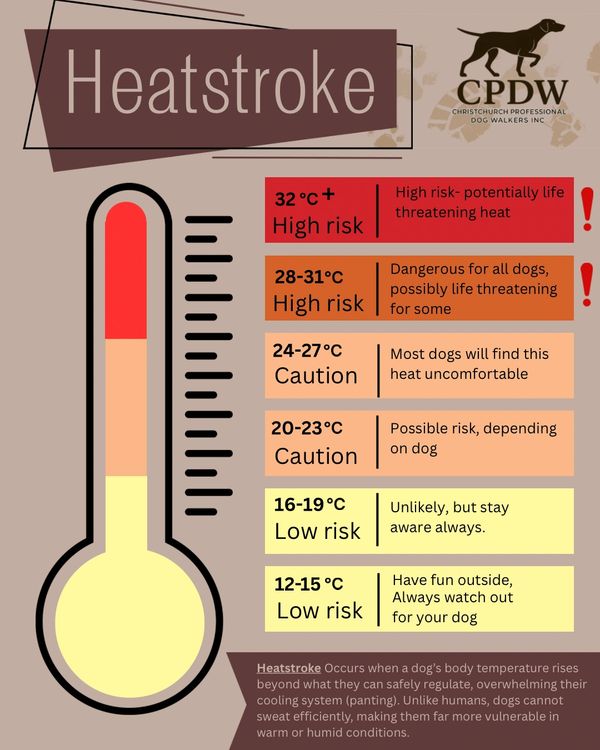
Heatstroke in dogs — NZ summer reminder
As temperatures rise across Aotearoa, heatstroke becomes a real and fast-acting risk for dogs — even on days that don’t feel extreme to us.
Dogs do not cool themselves like humans. They rely mainly on panting and limited sweating through their paws, which means overheating can happen quickly and become life-threatening.
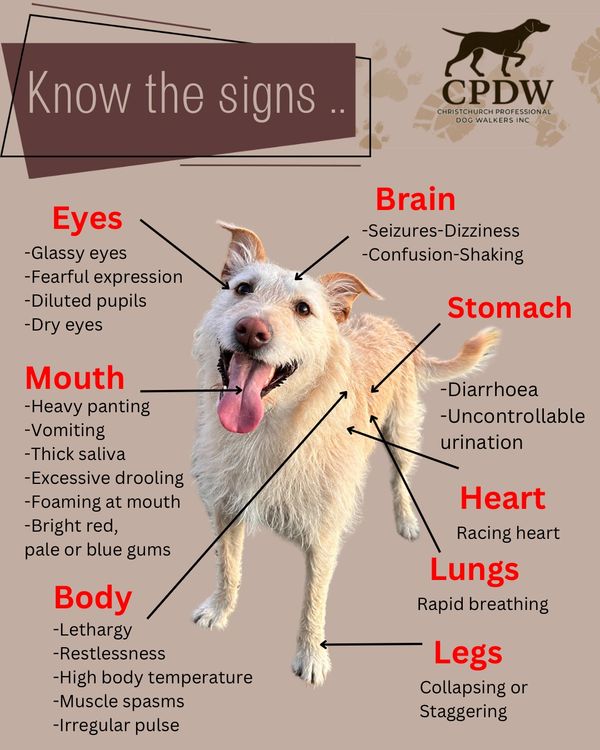
Early signs of heatstroke include:
• excessive or frantic panting
• drooling, thick saliva
• lethargy, weakness, wobbling
• vomiting or diarrhoea
• bright red or very pale gums
Advanced signs (medical emergency):
• collapse or seizures
• unresponsiveness
• very high body temperature
Prevention matters:
• walk early morning or late evening
• avoid hot pavements (if it’s too hot for your hand, it’s too hot for paws)
• provide shade and fresh water at all times
• never leave dogs in cars — even briefly
• adjust exercise to the dog, not the calendar
Heatstroke isn’t about “toughing it out” — it’s about informed, welfare-first decision-making.
If you suspect heatstroke: cool gradually, offer water (don’t force), and seek urgent veterinary care immediately.
Safe choices protect lives.
Summer awareness saves dogs.
⸻
Disclaimer:
This content is shared for public-interest and educational purposes only. It does not replace veterinary advice. If a dog is unwell or overheating, seek immediate professional care.

Education
Why constant ball throwing isn’t healthy for dogs
Fetch can be fun — but when ball throwing becomes repetitive, intense, and unstructured, it can negatively impact both a dog’s mental and physical wellbeing.
Mental impact
Constant ball throwing can:
• increase adrenaline and overall arousal
• create fixation and difficulty switching off
• reduce a dog’s ability to self-regulate
• interfere with learning around distractions, as high arousal overrides thoughtful processing
Over time, some dogs struggle to engage calmly with their environment unless the ball is present.
Arousal & reactivity
Repeated high-arousal states can:
• increase frustration when the ball is removed
• increase the likelihood or intensity of reactive responses
• make it harder for dogs to remain calm in shared public spaces
High-energy ball play can also impact other dogs nearby, particularly those working on calm behaviours, neutrality, or rehabilitation. Thoughtful use of shared spaces matters.
Physical impact
Repetitive sprinting, sharp turns, and sudden stops can:
• place strain on joints, spine, and soft tissue
• increase injury risk (especially shoulders and cruciate ligaments)
• prioritise speed over balanced, healthy movement and gait
A tired dog is not always a fulfilled dog
Physical exhaustion does not equal emotional regulation or meaningful enrichment.
Healthier alternatives
• sniffing and scent exploration
• varied terrain walks
• choice-based movement
• structured play with breaks
• calm, brain-engaging activities
So is fetch “bad”?
No — excessive, repetitive, unstructured ball throwing is the issue.
Intentional, occasional ball play with clear start and finish, rest periods, and balance can be part of a healthy routine.
The takeaway
Wellbeing comes from education, balance, regulation, and respect for shared spaces — not constant adrenaline.
Disclaimer:
This content is shared for general educational and animal-welfare purposes only. It does not replace individual veterinary or behavioural advice. Dogs have differing physical and emotional needs, and management should always be tailored to the individual.
Education
Children, Dogs & Parents: Learning Together
shared public spaces, children and dogs often cross paths — and positive interactions start with education, guidance, and supervision.
Young children are naturally curious and can move quickly or approach dogs at close range. Because children are often at eye level with dogs, these interactions can feel intense for a dog, particularly when the dog is on lead and unable to move away.
Across New Zealand, many dog-related incidents could be reduced through early education and awareness. Dog reactions are rarely sudden — they are often the result of stress building over time, with subtle signals going unnoticed.
Parents play an important role in supporting both their children and their dogs by:
- teaching children to always ask before approaching or patting a dog
- helping children understand when to give dogs space
- supervising interactions in dog parks and shared areas
- recognising that dog parks are designed for dogs, just as playgrounds are designed for children
When families take the time to teach safe interactions and respect boundaries, shared spaces become calmer and safer for everyone.
If challenges arise, seeking guidance from a qualified trainer or behaviour professional can be a positive, proactive step.
Education, understanding, and supervision help children and dogs grow together safely.
⸻
Disclaimer:
This content is provided for general educational purposes only. Children, dogs, and environments vary, and individual supervision, risk assessment, and professional guidance may be required. This information does not replace personalised training, behavioural assessment, or professional advice.
Education
Why who walks your dog matters
Walks aren’t just about distance or time.
They’re about how dogs move, regulate, and experience the world — and that depends on the knowledge and skill of the person on the lead.
Whether a dog is on-lead or off-lead, walking in educated, capable hands supports:
• healthy gait and functional movement
• emotional and stress regulation
• impulse control and behavioural stability
• balance, coordination, and endurance
• mental stimulation and wellbeing
• a strong human–canine bond
• long-term physical health and mobility
In cities where access is increasingly shaped by colour-marked and restricted areas, how dogs are managed — on or off the lead — matters more than ever.
Crowding dogs into limited spaces without considering handler skill, dog behaviour, or movement needs can unintentionally create stress, conflict, and welfare concerns.
- Safety isn’t created by colours on a map or by dog limits alone.
- Safety comes from education, effective management, accountability, and professional conduct.
Allowing four dogs in inexperienced hands directly contradicts the purpose of exemption compliance, which exists to recognise that managing multiple dogs requires skill, education, and risk assessment.
This is why professional, welfare-first dog walking matters — for dogs, the public, and shared spaces.
⸻
Disclaimer:
Educational content only. Outcomes vary depending on individual dog needs.

Education
Fireworks & Dogs
From a canine behaviour perspective, fireworks are a high-intensity, unpredictable stimulus. Sudden noise, vibration, and light activate the fight-or-flight response — even in dogs with no prior fear history.
Common responses include trembling, pacing, hiding, vocalising, and escape behaviour. These are involuntary stress responses, not bad behaviour.
Fear experienced inside the home can be just as impactful as outdoor exposure. Repeated or unmanaged stress may lead to noise-related phobias, which can generalise to other sounds, night-time environments, or being alone.
Preparation matters:
• walk dogs earlier while arousal is low
• secure doors and fences before dusk
• provide a quiet, familiar safe space
• reduce sensory input and use steady background noise
• allow choice — do not force exposure
In more severe cases, a veterinarian-led approach may be appropriate alongside behavioural management.
Fireworks are brief. Behavioural impact doesn’t have to be.
Disclaimer:
Shared for public-interest and educational purposes only. This does not replace individual veterinary or behavioural advice.
Education
Head collars
Head Collars: A Management Support Within a Training Plan.
Head collars are one of several temporary management options that may be used to support safe handling while training and learning are underway.
They work by guiding the dog’s head orientation and point of focus. Because a dog’s body naturally follows head movement, this can reduce pulling pressure and improve safety for both dog and handler — particularly for larger or stronger dogs, or in environments with higher levels of distraction.
Importantly, head collars are not a training solution on their own, nor are they a substitute for education or skill development.
Their use should always be:
• Individual-dog assessed
• Introduced gradually
• Paired with positive reinforcement
• Integrated into a broader training and learning plan
Successful use relies on:
✔️ Conditioning and counter-conditioning
✔️ Creating positive associations (yes… treatooo tax)
✔️ Allowing the dog time to adapt at their own pace
✔️ Ongoing observation of comfort, stress signals, and wellbeing
Head collars are best understood as a supportive management aid — not a fix, not a bandage, and not a standalone intervention.
Disclaimer
This content is provided for general educational purposes only. It does not constitute training instruction, behavioural advice, or an endorsement of any specific equipment. Suitability of tools varies between individual dogs and handlers. Decisions regarding training equipment should be made in consultation with appropriately qualified professionals, with consideration given to canine welfare, handler skill, and the specific context.
At CPDW Inc, we support education-led, welfare-focused decision making, recognising that appropriate tool use depends on the individual dog, the handler’s experience, and the training environment. Safety and welfare are outcomes of informed guidance — not equipment alone.
Education supports welfare. Welfare supports safety.
—
Christchurch Professional Dog Walkers Inc (CPDW Inc)
Not-for-profit | Education-led | Welfare-focused